
THE MIRROR CRACKS
A Rock Opera About Narcissism, Power
and the Need to Be Seen and Heard
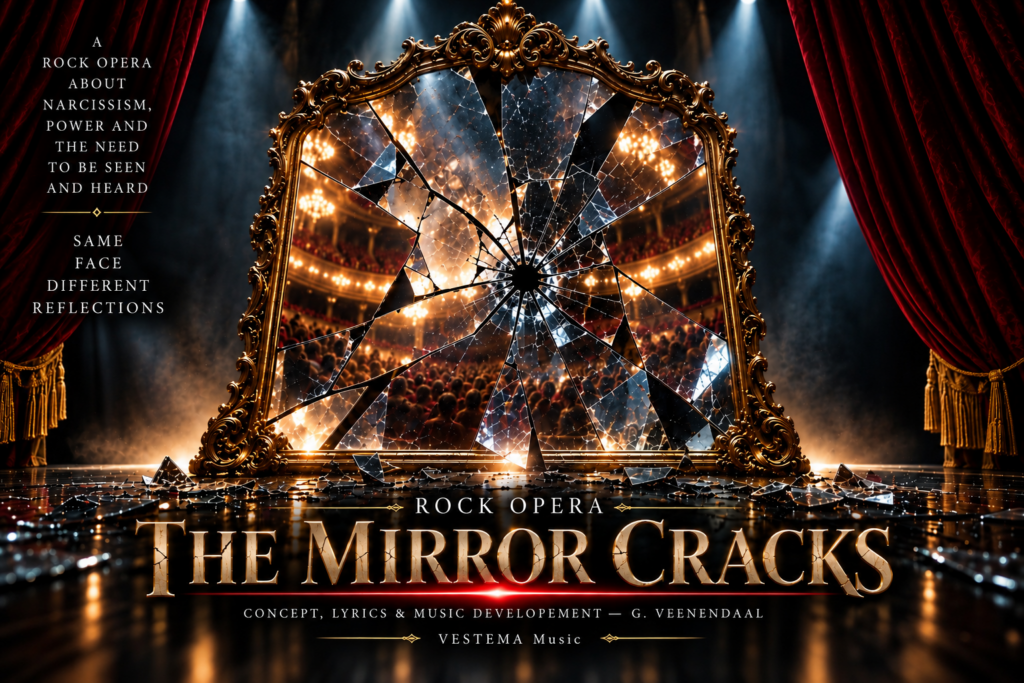
THE MIRROR CRACKS is an original English-language rock opera exploring narcissism, not as a diagnosis, but as a human pattern that can begin almost invisibly and grow into something destructive.
This is not the story of one narcissist. It is a journey through the narcissistic spectrum.
THE STORY
THE OUVERTURE – THE MIRROR
Here the journey begins.
A large multi-sided mirror is gradually constructed on stage while the music introduces the world of the production. As the mirror becomes complete, it catches the light from the auditorium.
Before a single character has spoken, the audience sees itself and is confronted with the central question:
Is this story about other people — or might we recognise something of ourselves?
THE BABY — SEE ME
All human life starts with a baby. A child enters the world with the most natural demand imaginable: See me.
There is nothing sinister about it. Every human being needs attention, recognition and love. But recognition can become expectation. Expectation can become entitlement. And entitlement can become power.
THE MOTHER — YOU OWE ME
The child becomes her little prince. He is special, exceptional, “highly gifted.” At first, her admiration appears loving and her pride seems unconditional. But gradually, expectations are attached to that love. His achievements become a reflection of her, his failures feel like a personal disappointment, and being special is no longer simply something he is — it becomes something he must continuously prove.
Everything she has done for him is remembered, repeated and eventually presented as a sacrifice. Gratitude becomes obligation, and love begins to carry an invisible price. Her achievements become his expectations. Her sacrifices become his debt. And eventually the message is unmistakable: You owe me.
THE FATHER — BECOME ME
Love acquires another condition. A father sees in his son not only a child, but someone expected to become the person his father has already imagined for him. His own ambitions, values and unfinished dreams become a blueprint for his son’s future. Approval follows when the boy makes the “right” choices; disappointment appears when he chooses a path of his own.
What looks like guidance gradually becomes expectation, and expectation becomes pressure. The son is not simply asked to succeed — he is asked to become a reflection of his father. The message is no longer: become who you are. It is: Become Me.
Then the outside world enters.
THE SCHOOL — PICK ME
Being seen is no longer enough. Now one must be chosen. Admired. Better than the others.
The child discovers competition, popularity and hierarchy and learns that making somebody else appear smaller can make you appear bigger.
The meaning of “See Me” has begun to change.
Then come adult relationships.
THE PARTNER — DEPEND ON ME
Love begins to change into dependency and control. What once felt like closeness slowly becomes a relationship in which one partner determines the emotional rules. Independence is discouraged, boundaries become inconvenient and affection increasingly comes with conditions. What looks like devotion from the outside gradually becomes a message: you need me, and life without me will be harder than life with me.
THE LOVER — BELIEVE ME
Seduction, truth and reality become intertwined. What begins with charm, attention and intimacy slowly turns into confusion. Words are denied, events are rewritten and contradictions are explained away until one partner begins to question their own memory and judgement. The issue is no longer what actually happened, but whose version of reality ultimately prevails. If you doubt yourself long enough, believing me becomes easier than believing you.
THE FRIEND — UNDERSTAND ME
Friendship appears equal until listening, loyalty and understanding begin to flow predominantly in one direction. Conversations increasingly return to the same person, support becomes expected rather than exchanged, and your successes are welcomed only as long as they do not overshadow theirs. The friend slowly becomes an audience, an ally and a source of validation. Your problems matter when they provide an opportunity to advise, rescue or feel important — but when you need genuine support, the balance suddenly changes. Friendship is no longer about understanding each other. It becomes about understanding me.
Then we enter the workplace.
THE SECRETARY — YOU’LL REGRET ME
Attention acquires a more dangerous meaning.
An older secretary becomes emotionally attached to a colleague. As long as her attention is accepted, she is helpful and protective. When her affection is rejected, idealisation turns into wounded pride and revenge, and her knowledge of schedules, contacts, documents and vulnerabilities becomes a weapon.
After this personal and relational world, a new movement begins.
REPRISE – THE RISE
An instrumental interlude marks the transition towards status, hierarchy and power. A simple musical idea begins small and continues to rise. Piano is joined by bass, drums, Hammond organ, orchestra, brass, choir and electric guitar. Layer by layer, the music climbs.
From this moment onward, the scale of the narcissism changes.
THE MANAGER — FOLLOW ME
Power becomes organisational. Leadership is no longer about bringing out the best in others, but about maintaining authority, controlling information and protecting position. Ideas are dismissed when they come from below, only to reappear later as the manager’s own. Success travels upwards; responsibility for failure travels downwards.
Loyalty becomes more valuable than honesty, disagreement is interpreted as disobedience, and talented employees can become a threat rather than an asset. Those who follow are rewarded; those who question may find themselves excluded or blamed. Your idea is worthless until it becomes mine. Your failure is yours — my success belongs to me. Follow Me.
THE MAYOR — ADMIRE ME
Recognition becomes public. Status now exists because other people confirm it: applause, photographs, invitations, influential contacts and the constant need to be seen. Public service gradually becomes a stage on which admiration is measured by who attends, who applauds and whose name appears beside his.
Those below him are expected to show respect, while those above him are approached with charm and deference. Being photographed with someone more powerful makes him feel more important; being overlooked, excluded or replaced feels like an insult. Behind the confidence lies an uncomfortable question: if the cameras turn away and nobody calls my name, do I still matter?
The need to be seen has grown into the need to be admired. Admire Me.
THE POLITICIAN — TRUST ME
Perception becomes more important than truth. Politics becomes a world of handshakes, cameras, receptions and carefully cultivated relationships, where trust can be turned into influence and influence into power. Principles remain important — until circumstances make another version of them more useful.
Friends are valuable while their status reflects well on him. Rules are essential, although leadership may require exceptions when those rules become inconvenient. Criticism is redirected, opponents are diminished and uncomfortable questions are answered with another question. What matters is not always what is true, but what people can be persuaded to believe.
Yet behind the confidence, the photographs and the endless public recognition lies something far more fragile: Who am I when nobody knows my name?
The answer must never be discovered. So shake my hand, stand beside me and Trust Me.
The journey is approaching its most extreme form.
THE KING — OBEY ME
The King no longer asks to be seen. He no longer asks to be admired. He no longer asks to be trusted.
He expects obedience.
At first, everything is magnificent. His kingdom prospers. Trumpets and French horns announce his presence, the palace shines and the King is delighted with the extraordinary man he sees reflected in the enormous mirror.
He understands the system better than anybody else. His intelligence is beyond question. Whatever succeeds, he built. Whatever prospers, he created.
But slowly, reality begins to interfere with the reflection. People whisper. Questions are asked. Promises remain unfulfilled. And when reality no longer confirms the reflection, reality itself becomes the problem.
The King does not change. The rules must change.
A law stands in my way? The law must obey.
In the closing scene, THE MINISTER appears.
The King proudly lists his achievements. The Minister quietly corrects him. The palace was never completed. Half the fleet never sailed. Three wars are still being fought. The treasury is empty. Finally, the King declares:
“The people love me!” The Minister hesitates.
“No, sir… they’re leaving.” The King fires him.
“You’re fired.” A brief silence. Then, instantly cheerful again:
“Next!”
Reality has once again been removed. But not for long.
THE WARNING — YOU CAN’T STAY
For the first time, the production openly signals that unchecked power cannot continue indefinitely. Because THE KING has arrived. People begin to see what is happening. Boundaries have been crossed. Power is being abused. Contradiction is no longer tolerated. The warning is simple: power given by people can also be taken away by those same people.
But the warning does not produce self-reflection. It produces resistance. Anyone who contradicts him becomes part of the problem.
INSTRUMENTAL INTERLUDE — THE KINGDOM FALLS
What follows is not an explosion. It is not the spectacle of collapsing towers.
It is a majestic dismantling.
In darkness, the great mirror structure is turned 180 degrees. When the light returns, the audience sees the same mirror that has witnessed the entire journey but now a huge crack runs across its surface.
Then the opening of the production begins to reverse itself.
During THE OUVERTURE, the cast constructed the mirror piece by piece. Now they remove it. Mirror by mirror. At the same time, the King stands at the top of a staircase.
With every step down, another symbol of his status is taken away: his crown, his royal cloak, his decorations and the outward signs that once distinguished him from everybody else. Step by step, he descends.
Mirror by mirror, his constructed world disappears.
By the time he reaches the bottom of the staircase, the King has become an ordinary man. No crown. No title. No elevated position. No mirror in which to admire his own greatness.
For the first time, he stands at exactly the same level as everyone else. And nobody is looking at him.
THE VICTIMS — MAYBE IT WAS ME
But the story does not end with the narcissist. The perspective changes. For the first time, we hear the voices of those who lived beside him. The partner. The child. The colleague. The friend. People who doubted their own memories, changed their behaviour to avoid conflict, tried harder, gave more and slowly lost parts of themselves.
Many victims do not even realise that they are victims. Money may be gone. Dignity eroded. Friends and family pushed away. Isolation has become normal. And despite everything, they may still love the person who hurt them.
So there is no accusation. There is doubt.
Maybe it was me.
Maybe I asked too much. Maybe I should have listened better. Maybe I should have trusted more. Maybe I should have loved more.
The victim looks into the mirror and sees a woman she barely recognises someone who once laughed louder, had more to say and knew where her boundaries were. But in the silence, something begins to change.
A first crack appears in the self-blame:
And I still don’t know what happened to me…
But the silence helps me see…
Maybe I wasn’t asking too much…
Maybe the problem wasn’t me.
It is not yet an answer. But for the first time, she is asking the right question.
THE LESSONS — I RECOGNISE YOU
The final movement is not about revenge. Nor is it any longer about trying to understand or change the narcissist. It is about recognition. Recognising the pattern before you lose everything: your money, your family, your friends, your dignity. The constant need for admiration. The gradual shifting of boundaries. The double standards. The rewriting of reality, the lies and distortions. The irritation when challenged. The expectation of loyalty and obedience.
Understanding these patterns does not mean diagnosing another person. It means recognising what is happening early enough to make your own choices.
This is explicitly not about gender. Narcissistic patterns are not limited to any particular gender. THE MIRROR CRACKS therefore uses characters of different genders to portray different parts of the spectrum. As the production moves towards status, politics and extreme power, a dramaturgical choice was made to represent the central figures more often as men. This is a creative choice within the story, not a statement about who displays narcissistic behaviour.
The journey began with a child asking:
“See me.” Over time, the requests became demands:
“Depend on me.” “Believe me.” “Understand me.” “Follow me.”
“Admire me.” “Trust me.” “Obey me.”
The final answer does not have to be an attack. It can be much simpler:
I recognise you. I see through you.
Not: I know everything about you. But: I recognise the pattern. I recognise what is happening. And this time, I recognise it in time.
Recognition, however, is not the same as condemnation. And understanding does not mean that you have to accept everything. Perhaps somewhere along this journey you recognised someone. A partner, a parent, a friend, a colleague or perhaps even something of yourself.
That is precisely why, at the beginning of this production, the mirror was turned towards the audience.
Not to ask: Who is the narcissist? But to ask:
What do I recognise and what do I do with that recognition?
Because patterns can be broken. Boundaries can be restored. Relationships with friends and family can sometimes be rebuilt. What seemed lost can sometimes be found again. And those who have lost themselves along the way can learn to trust again what they see, what they feel and what they know.
The production began with a child asking:
“See me.”
Perhaps the most important voice
at the end is your own:
“I see me now.”
THE MIRROR CRACKS
An original English-language Rock Opera.
Concept, lyrics & music development by Gerrit A. Veenendaal VESTEMA Music©
Demo material is available to invited guests and professional partners in the